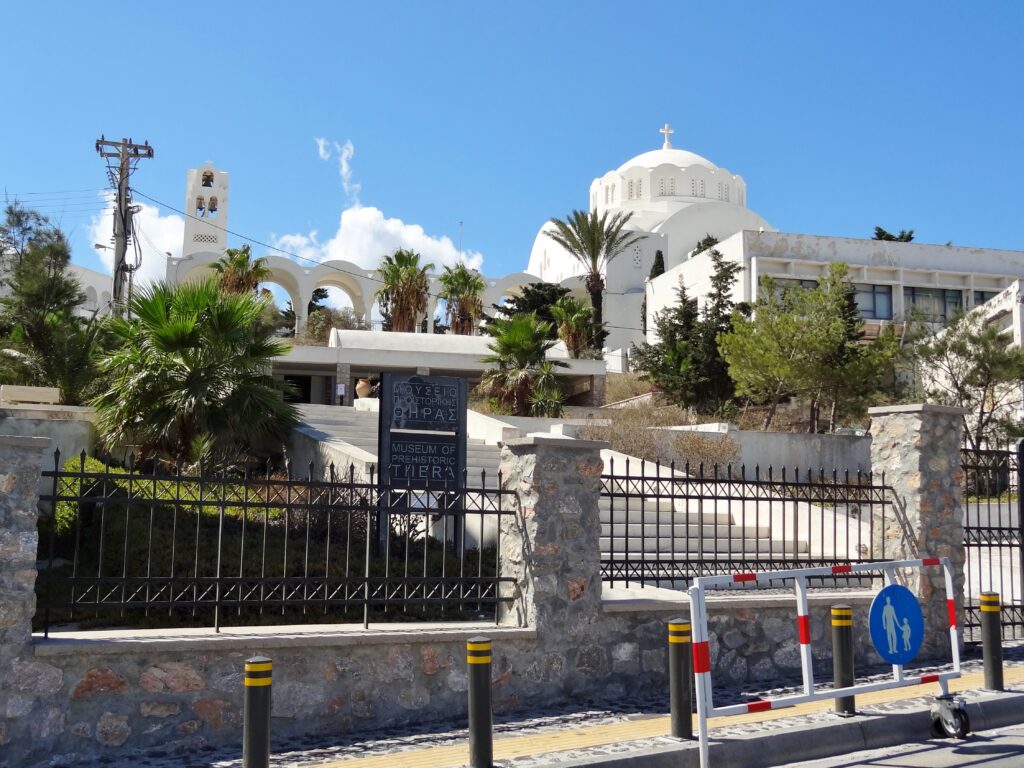
It was built in 1960 by the Ministry of Public Works in order to replace the old museum (built in 1902), which had collapsed during the earthquakes of 1956.
The Museum contains the following collections:
- Sculpture, ranging from the Archaic to the Roman period.
- Inscriptions, ranging from the Archaic to the Roman period.
- Vases and clay figurines, dating from the Geometric to the Hellenistic periods.
The most important items of the exhibition are:
Inv. no. 1783.
Theran amphora with geometric decoration. Representative example of a local workshop, the production of which begins at the end of the 8th century B.C. and lasts until the 6th century B.C. It was found at the Archaic cemetery of Ancient Thera and dates from the beginning of the 7th century B.C.
Inv. no. 777.
Amphora from the Archaic cemetery of Ancient Thera. It is attributed to an island workshop and dates to the beginning of the 7th century B.C.
Inv. no. 1320.
Large pithos with relief decoration. A brilliant example of 7th century B.C. Cycladic art, but also the unique specimen on Thera. The metope on the neck of the vase is decorated with a swan and the band on the shoulder shows two chariots drawn by winged horses. It comes from a child-burial at the cemetery of Ancient Thera, on the north slope of Mt. Sellada. Dated to ca. 675 B.C.
Inv. no. 306.
Upper part of an Archaic funerary kouros. It is one of the earliest known colossal statues, found at the cemetery of Ancient Thera, on the west slope of Sellada. Dated to the end of the 7th century B.C.
Inv. no. 307.
Torso of an Archaic funerary kouros from the cemetery of Ancient Thera, on the west slope of Sellada. Dated to the end of the 7th century B.C.
Inv. no. 392.
Clay Daedalic figurine covered with painted decoration of which the colour is still well preserved. Because of the characteristic movement of the arms towards the head, it is interpreted as a lamenter. Dated to the end of 7th century B.C.
Inv. no. 1772.
Attic black-figure amphora. On the front side, Athena and Heracles are shown riding a quadriga, while in the background are depicted Apollo playing the lyre, and Artemis. The reverse side is decorated with two horsemen flanked by an archer and a hoplite. The dead person’ s name is engraved on the lip of the vase. It was found at the Archaic cemetery of Ancient Thera and dates from the second half of 6th century B.C.
Inv. no. 1773.
Attic black-figure kylix. On the outer surface of the vase, a chariot battle and a duel between two hoplites are depicted between scenes of departing warriors. On the interior, six ships are shown on the lip and Poseidon in the centre, killing the giant Polybotes. On the base, two horsemen are depicted on either side of a hoplite. It was found at the Archaic cemetery of Ancient Thera and dates from the second half of the 6th century B.C.
Inv. no. 1774.
Attic black-figure volute krater. On the neck are depicted scenes of battle with chariots, in which godess Athena participates. The inner surface of the rim is decorated with four ships. From the Archaic cemetery of Ancient Thera, dated to the second half of the 6th century B.C.
Inv. no. 509.
Volcanic (trachyte) boulder, weighing 480 kilos. It was lifted by the athlete Eumastas with his bare hands and his achievement is commemorated in an inscription on the stone itself: “Eumastas, son of Kritobolos, lifted me off the earth”.