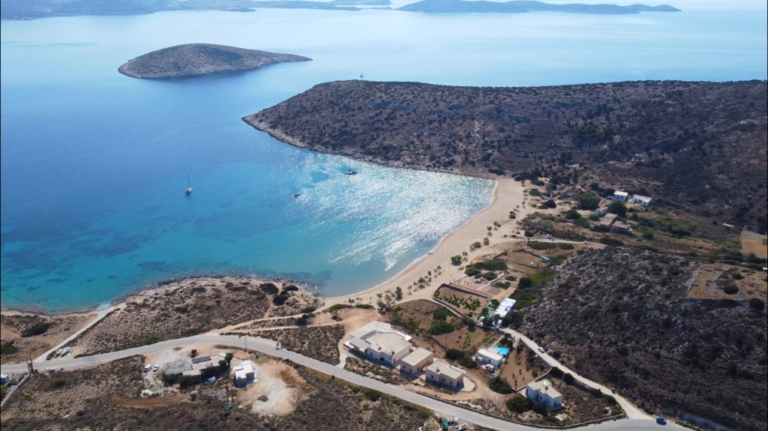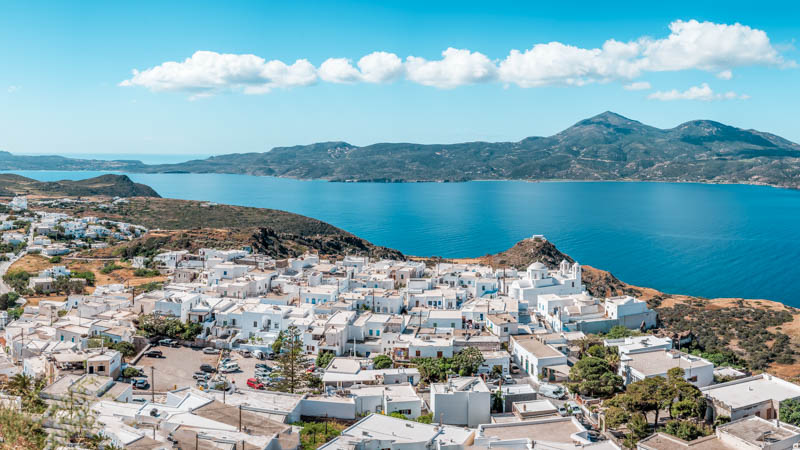
Situated in the south western corner of the Cyclades, most of Milos’ 161 square kilometres are parched, multi-hued, volcanic rock – a geologist’s dream. The shoreline is tortured by steep cliffs, sea caves, subsurface rocks and small islands. Minerals and ores are in abundance, their treasures mined in outlying areas and scarring the barren landscape. Villages cling to slopes or nestle at the water’s edge in sandy coves. In short, a healthy local economy, low-key tourism and a landscape more akin to the moon than mother earth make for a rather unique Greek Island holiday.
The main harbour area of Adamas and the sleepy fishing village of Apollonia are the two centres where our accommodation is located. Rising on a gentle hillock, Adamas has excellent tavernas and cafes with good transport links to the most superb beaches on the south coast. Apollonia’s quaint little harbour lies adjacent to a superb tree-fringed, sandy bay. A handful of local shops and tavernas are the limit to any tourist development so sun, sea, sand and good food are the order of the day although are bus links with Adamas.
History: Milos dominates, due to its natural position, the sea of the Cyclades. Its shape is petal-like and it forms to the northwest the largest natural port of the Mediterranean, and is one of the safest ports for the anchorage of both small boats and large ships. The most possible explanation of this geological peculiarity is that probably the port itself used to be the crater of a great volcano that sank during its explosion like the one of Santorini. It is mostly a volcanic island. The volcano Fyriplakas to the south of the island has a crater 1.700m in diameter and 30 m in height. The volcanic period in Milos should have had lasted for millions of years.
That’s why one may still easily come to the conclusion that the various fossils are the results of this activity. Another result of the volcanic activity are the thermal springs, some of which are considered to possess healing abilities, The island also has a rich underground which is a great source of wealth for Milos. Plaster, salt, caoline, betonite, perlite and the fabled obsidian, volcanic rock, very tough black in color that is used since the ancient times for the making of tools etc.
Legend reports it that Milos was the name of the first emigrant who was sent by the goddess Venus to the island. The Phoenicians were the first inhabitants. They was affected with their art, the inhabitants, who developed themselves into wonderful potters, whose artwork you may admire in the Museum of Milos and the Archaeological Museum Of Athens. As a member of the Athenian Alliance, Milos participates to the naval battle of Salamis and resists the Persians. Later in, the alliance with the Spartans against the Athenians, cost them dearly, after winning the Peloponnesian war, the Athenians, killed and the men and sold the women and children to the slave market.
In the 4th century the inhabitants of Milos embrace Christianism and the monuments of that period are the catacombs and the old christian baptismal places that lie interspersed along the island. In the years of the Turkish domination, the inhabitants of Milos had been able to define from among themselves their ruler. They participated in the revolution of 1821.
Milos continues to affect the modern history of Greece. lt’s important to say here that in the island the godess Venus was worshipped in a special manner. One of the most admirable objects of worshipping and a sublime example of Art, the Aphrodite (Venus) of Milos which was discovered in 1820 in a cave in Plaka of Milos and is considered a work of art of the Hellenistic years, was stolen by the French and decorates the Museum of Louvre. A copy of the statue stands in the Museum of Milos.