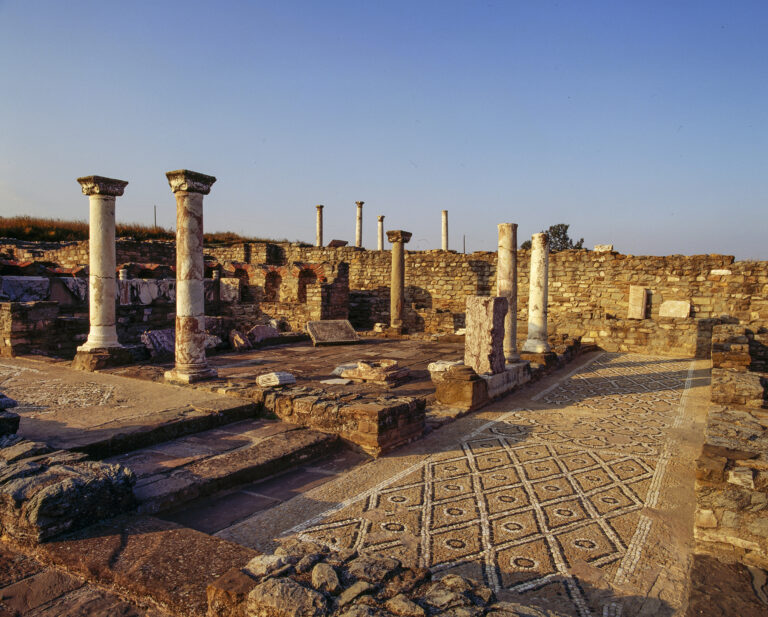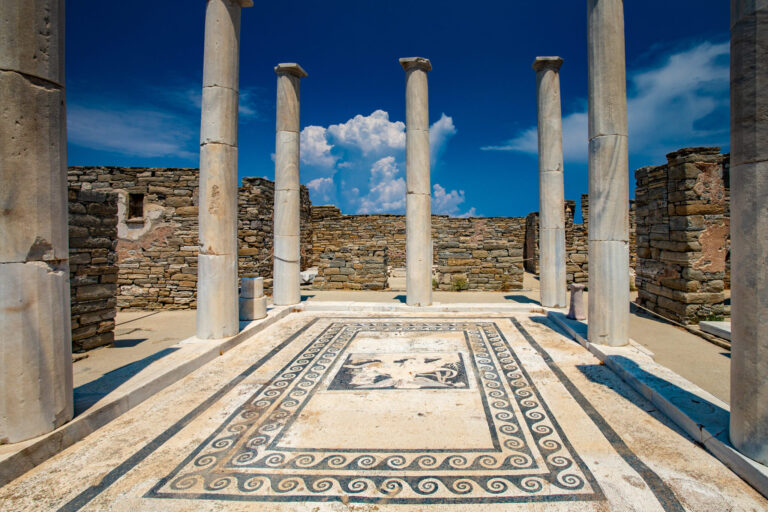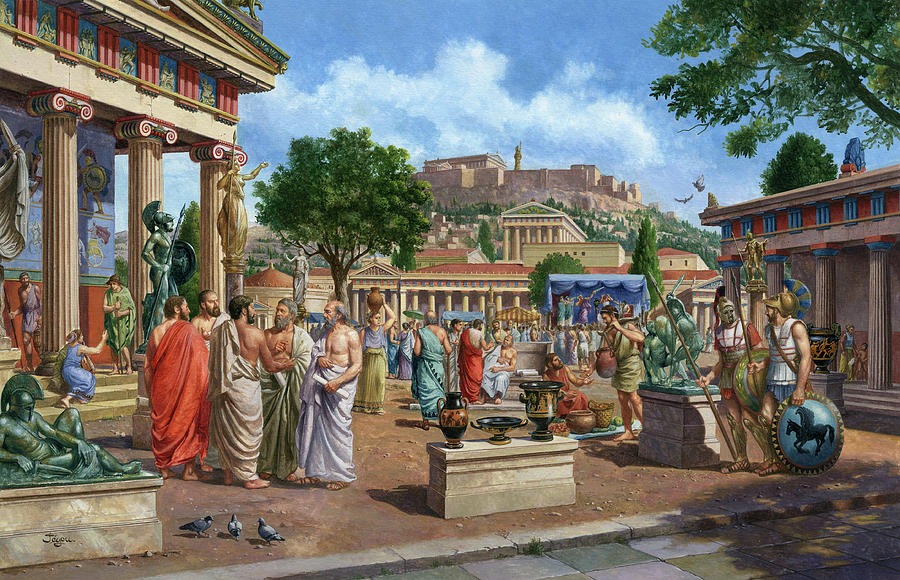
The Agora in ancient Greek cities was an open space that served as a meeting ground for various activities of the citizens. The name, first found in the works of Homer, connotes both the assembly of the people as well as the physical setting; it was applied by the classical Greeks of the 5th century BC to what they regarded as a typical feature of their life: their daily religious, political, judicial, social, and commercial activity. The agora was located either in the middle of the city or near the harbour, which was surrounded by public buildings and by temples. Colonnades, sometimes containing shops, or stoae, often enclosed the space, and statues, altars, trees, and fountains adorned it. The general trend at this time was to isolate the agora from the rest of the town. Earlier stages in the evolution of the agora have been sought in the East and, with better results, in Minoan Crete (for instance, at Ayiα Triαdha) and in Mycenaean Greece (for instance, at Tiryns).
In the 5th and 4th centuries BC two kinds of agora existed. Pausanias, writing in the 2nd century AD, calls one type archaic and the other Ionic. He mentions the agora of Elis (built after 470 BC) as an example of the archaic type, in which colonnades and other buildings were not coordinated; the general impression created was one of disorder. The agora of Athens was rebuilt to this type of design after the Persian Wars (490-449 BC). The Ionic type was more symmetrical, often combining colonnades to form either three sides of a rectangle or a regular square; Miletus, Priene, and Magnesia ad Maeandrum, cities in Asia Minor, provide early examples. This type prevailed and was further developed in Hellenistic and Roman times. In this later period the agora influenced the development of the Roman forum and was, in turn, influenced by it. The forum, however, was conceived in a more rigid manner than the agora and became a specific, regular, open area surrounded by planned architecture.
The use of the agora varied at different periods. Even in classical times the space did not always remain the place for popular assemblies. In Athens the ecclesia, or assembly, was moved to the Pnyx (a hill to the west of the Acropolis), though the meetings devoted to ostracism were still held in the agora, where the main tribunal remained.
A distinction was maintained between commercial and ceremonial agoras in Thessaly and elsewhere (Aristotle, Politics, vii, II, 2). In the highly developed agora, like that of Athens, each trade or profession had its own quarter. Many cities had officials called agoranomoi to control the area.
The agora also served for theatrical and gymnastic performances until special buildings and spaces were reserved for these purposes. In Athens respectable women were seldom seen in the agora. Men accused of murder and other crimes were forbidden to enter it before their trials. Free men went there not only to transact business and to act as jurors but also to talk and idle–a habit often mentioned by comic poets. In exceptional circumstances a tomb in the agora was granted as the highest honor for a citizen.