|
History
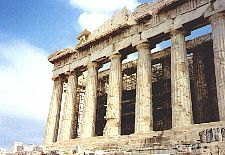 Greece has a history stretching back almost 4.000 years. The
people of the mainland, called Hellenes, organised great naval
and military expeditions, and explored the Mediterranean and
the Black Sea, going as far as the Atlantic Ocean and the
Caucasus Mountains. One of those expeditions, the siege of
Troy, is narrated in the first great European literary work,
Homer's Iliad. Numerous Greek settlements were founded
throughout the Mediterranean, Asia Minor and the coast of
North Africa as a result of travels in search of new markets.
Greece has a history stretching back almost 4.000 years. The
people of the mainland, called Hellenes, organised great naval
and military expeditions, and explored the Mediterranean and
the Black Sea, going as far as the Atlantic Ocean and the
Caucasus Mountains. One of those expeditions, the siege of
Troy, is narrated in the first great European literary work,
Homer's Iliad. Numerous Greek settlements were founded
throughout the Mediterranean, Asia Minor and the coast of
North Africa as a result of travels in search of new markets.
During the Classical period (5th century B.C.), Greece was
composed of city-states, the largest being Athens, followed by
Sparta
and Thebes. A fierce spirit of independence and love of
freedom enabled the Greeks to defeat the Persians in battles
which are famous in the history of civilization -Marathon, Thermopyles,
Salamis and Platees.
In the second half of the 4th century B.C., the Greeks, led by
Alexander the Great, conquered most of the then known world
and sought to Hellenize it.
In 146 B.C. Greece fell to the Romans. In 330 A.D. Emperor
Constantine moved the Capital of the Roman Empire to
Constantinople, founding the Eastern Roman Empire which was
renamed Byzantine Empire or Byzantium for short, by western
historians in the 19th century. Byzantium transformed the
linguistic heritage of Ancient Greece into a vehicle for the
new Christian civilization.
The Byzantine Empire fell to the Turks in 1453 and the Greeks
remained under the Ottoman yoke for nearly 400 years. During
this time their language, their religion and their sense of
identity remained strong.
On March 25, 1821, the Greeks revolted against the Turks, and
by 1828 they had won their independence.
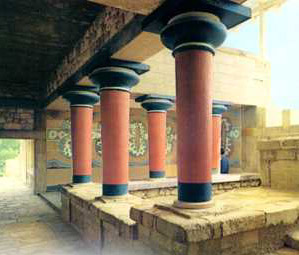 As the new state comprised only a tiny fraction of the
country, the struggle for the liberation of all the lands
inhabited by Greeks continued. In 1864, the Ionian islands
were added to Greece; in 1881 parts of
Epirus and
Thessaly. Crete, the islands of the
Eastern Aegean and Macedonia were
added in 1913 and western Thrace in 1919. After World War II
the Dodecanese islands were also returned to Greece.
As the new state comprised only a tiny fraction of the
country, the struggle for the liberation of all the lands
inhabited by Greeks continued. In 1864, the Ionian islands
were added to Greece; in 1881 parts of
Epirus and
Thessaly. Crete, the islands of the
Eastern Aegean and Macedonia were
added in 1913 and western Thrace in 1919. After World War II
the Dodecanese islands were also returned to Greece.
During World War II, Greece as occupied by Bulgaria, Germany
and Italy. A government in exile was established in
1944. By 1945 the World War was over, but the internal
struggle between left and right-wing factions raged. When the
dust settled, Alexandros Papagos and Konstantinos Karamanlis
were the leaders of new conservative coalition parties; with
the aid of the Marshall Plan, political and economic
conditions stabilized, but left the country dependent on
foreign aid.
In the election of 1950, no fewer than forty-four
parties contended for 250 parliament seats. The
Populists, Liberals, and National Progressive Center
Unionfinally formed a coalition government headed by
General Plastiras. At this time, they still had a
constitutional monarchy under King Paul. Social conditions
declined despite economic growth, leading to successful
military coups in 1963 and 1967. Crowding into cities caused
demands for social welfare and better income distribution.
"The Colonels" remained in power until 1973, heading
a reign of terror. A Turkish invasion of Cyprus in 1974
allowed an opportunity to unseat the military dicatorship. A
new constitution was written, and once again, elections were
held. This time, they elected to abolish the monarchy,
and Greece once again established a republic, the type of
government it enjoys today.
|